
One common misconception among US crypto traders is that logging into an exchange like OKX either exposes you to excessive security risk or is needlessly complex because it mixes custody, DeFi, and exchange features. That half-truth deserves unpacking: OKX combines centralized exchange functionality with self-custodial Web3 tools, and each of those choices has different security models and user responsibilities. Understanding how the login, account protections, and product mix work — and where they fail — is the single most practical step toward safer, more effective trading.
This article walks through how OKX’s account and login systems operate in practice, corrects three common misunderstandings, compares OKX’s approach with two alternatives, and ends with decision-useful heuristics for traders in the US who want to access spot, margin, or derivatives markets. We’ll also note a recent routine delisting so you can see how platform governance affects access and risk.
How OKX Login and Account Protections Actually Work
Mechanism first: OKX uses a layered authentication model. Account creation involves Know Your Customer (KYC) verification — you upload a government ID and complete a facial liveness check — which ties an account to a verified identity for AML compliance. That verification is a legal requirement, not a convenience feature; it limits anonymity but enables fiat rails and regulatory compliance.
Once an account exists, OKX enforces Two-Factor Authentication (2FA) — SMS, Google Authenticator, or biometrics on mobile — plus mandatory AI-driven monitoring that flags anomalous logins in real time. For an extra layer, users can pair the account with hardware wallets when interacting with the non-custodial Web3 wallet. For many traders, the practical consequence is this: a breach that extracts credentials is less likely to immediately drain funds if 2FA and device binding are active.
That said, OKX is hybrid: it stores over 95% of custodial assets in offline, multi-signature cold wallets to limit large-scale theft. This is an industry-standard risk-reduction mechanism. It reduces the probability of a catastrophic platform-wide loss, but it does not remove single-account risks (phishing, SIM swap, reused passwords) or risks associated with the non-custodial wallet where users control their own seed phrases.
Myth-Busting: Three Common Misconceptions
Misconception 1 — “KYC removes all privacy.” Not true in practice: KYC ties on-exchange balances to identity for regulatory purposes, but it does not automatically publish your holdings on-chain or reveal off-exchange activity. The trade-off is clear: KYC permits fiat services and institutional access at the cost of reduced pseudonymity.
Misconception 2 — “All exchange assets are equally safe.” Not true: OKX distinguishes custodial (CEX) holdings from assets you place in its self-custodial Web3 wallet. Custodial holdings gain cold-storage protection and Proof of Reserves transparency; self-custodial holdings rely on your seed management and any hardware wallet you attach. These are different threat models — one protects against exchange hacking, the other against exchange misbehavior — and they require different operational practices.
Misconception 3 — “Derivatives leverage is just a tool for profit.” The reality is leverage up to 125x for certain perpetuals and options drastically increases liquidation risk and sensitivity to slippage and funding costs. Leverage multiplies both gains and microstructure-related losses; above modest multipliers, execution risk (wide spreads, latency) often dominates strategy returns.
Comparing OKX with Two Alternatives: Centralized, Non-Custodial, and Hybrid Trade-offs
Alternative A — Pure centralized exchange (e.g., a major US-regulated exchange): These platforms may have stronger local regulatory safeguards and, sometimes, FDIC-like protection on fiat rails. They prioritize KYC and custodian insurance models. Trade-off: often less native Web3 integration and limited direct seed control.
Alternative B — Pure non-custodial DeFi access (wallets + DEXs): You retain full control via private keys; there’s no KYC barrier and no custodian to fail. Trade-off: you accept irreversible risk if you lose your seed or fall for contract exploits. Liquidity and execution tools are also different — aggregated routing can find swaps but lacks the matched order-book features and derivative contracts available on CEXes.
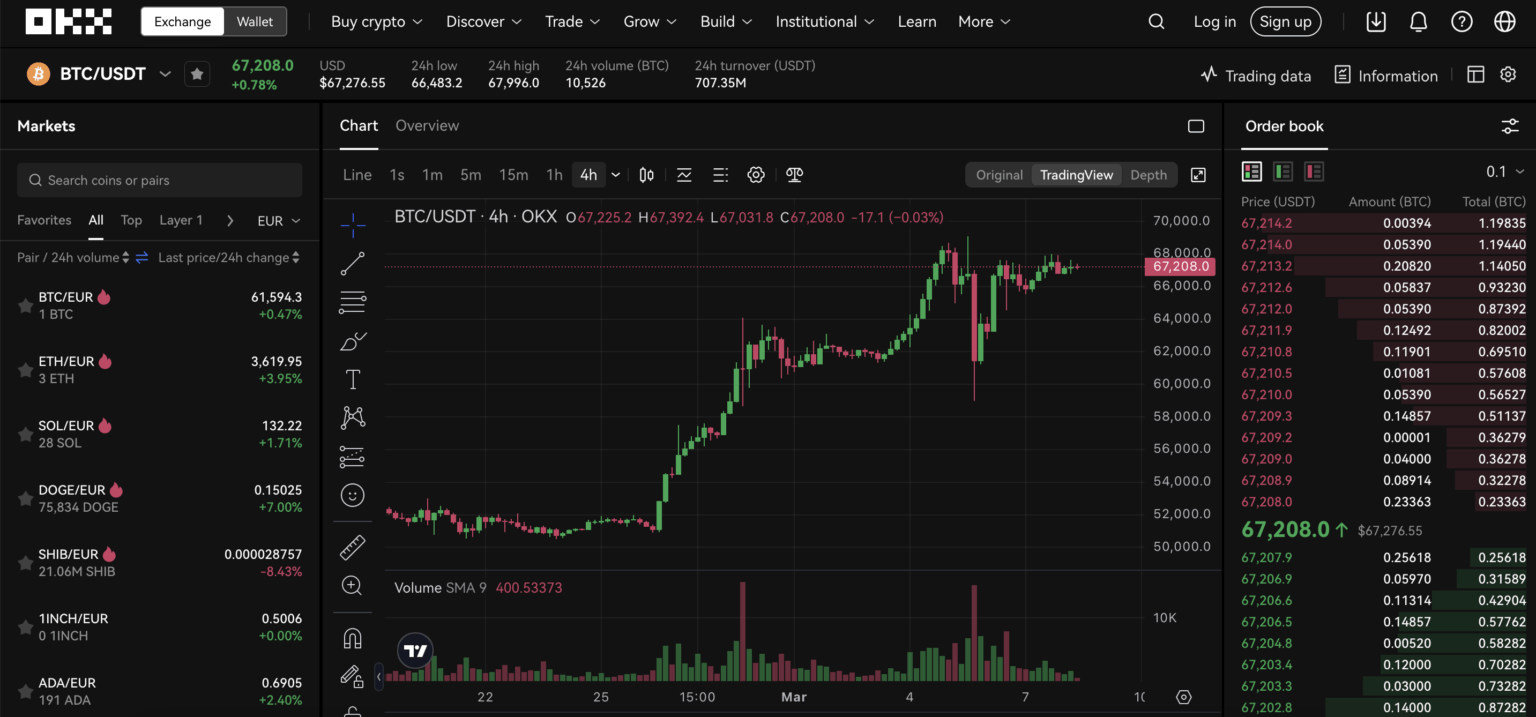
Where OKX sits: hybrid. It offers order-book spot and derivatives with institutional-grade charting and margin, while also providing a non-custodial wallet and DEX aggregator. This hybrid model aims to reduce switching costs between on-chain and off-chain activities but requires users to select the correct custody mode for each goal and to understand the distinct risk exposures.
What Recently Happened — And Why It Matters
This week OKX announced the delisting of several spot trading pairs, a routine governance action intending to maintain market quality. Delistings are a reminder that exchanges curate listings based on liquidity and compliance considerations. For traders, delisting means reduced access to thin assets on a CEX and, occasionally, forced conversions. It underscores a broader point: custody choice matters because when a token is delisted from a centralized venue, on-chain options via your non-custodial wallet may remain the last path for access.
Where OKX Breaks: Limitations and Operational Risks
Operational limits are not just hypothetical. The platform faces market risks (volatility, slippage), custodial limits (withdrawal windows in extreme stress), and user-side hazards (phishing, SIM swaps, seed loss). The non-custodial wallet introduces smart-contract risks: interacting with DeFi through the DEX aggregator can expose you to exploit-prone code, front-running, or bridging failures. Proof of Reserves increases transparency but does not eliminate execution or counterparty risk during market outages.
For US traders, regulatory uncertainty is an extra layer: access to specific products or listings can shift if policies tighten. That affects which derivatives are offered and the leverage available. Monitor product notices and your account notifications closely; routine maintenance and governance changes are how exchanges try to prevent systemic risk, but they also change the ground under traders’ strategies.
Decision-Useful Heuristics (Practical Rules)
1) Separate custody by purpose: keep capital for active leveraged trading in custodial accounts with strict 2FA; keep long-term holdings in a hardware-backed self-custodial wallet. 2) Treat extreme leverage as a short-duration tactical tool — test execution with small sizes first to understand slippage and funding dynamics. 3) Use the exchange’s Proof of Reserves and cold-wallet statements as part of your counterparty assessment, not proof of absolute safety. 4) When logging in, prefer biometric or authenticator-based 2FA over SMS if possible, and use unique passwords and a reputable password manager. 5) If you depend on cross-chain transfers, account for bridge failure modes and verify routes the DEX aggregator chooses before executing large swaps.
What to Watch Next
Watch product notices and listing updates. Exchanges adjust trading pairs and leverage policies in response to liquidity and regulatory signals; a small delisting today can signal a stricter listing posture tomorrow. Watch funding-rate behavior on high-leverage perpetuals — persistent skew or extreme rates indicate structural stress in that market. And monitor regulatory developments in the US that might affect derivative offerings or custody rules; these are slow-moving but meaningful for product availability.
FAQ
How do I log into OKX safely from the US?
Register and complete KYC, enable 2FA (preferably app-based), avoid SMS if you can, and consider biometric login on mobile. Use the exchange for active trading and move long-term holdings into a hardware-backed non-custodial wallet. For step-by-step access, the exchange’s official login page and help center detail the current flow; for an accessible guide to the web login process see okx login.
Is it safer to keep everything in OKX’s custodial wallet or my own Web3 wallet?
It depends on threat model and competence. Custodial storage reduces your responsibility for seed management and benefits from cold-storage risk controls, but you accept counterparty risk. Self-custodial wallets give you sole control and remove custodian counterparty risk, but losing your seed or falling for a phishing DApp can cause permanent loss. Use a split strategy: custodial for active trading; self-custodial for long-term holdings you control with a hardware wallet.
What do I need to know about trading with leverage on OKX?
Leverage magnifies both returns and risks. OKX offers up to 125x on certain derivative markets and up to 10x for margin trading on spot. Higher leverage raises liquidation probability and sensitivity to slippage; ensure you understand margin maintenance, funding rates, and the platform’s liquidation mechanisms before opening sized positions.
Do Proof of Reserves mean my funds are fully safe?
Proof of Reserves provides on-chain evidence that the exchange holds assets backing user deposits at a point in time, improving transparency. It does not eliminate operational, regulatory, or market risks — nor does it protect you from account-level attacks like phishing. Treat it as one piece of counterparty due diligence, not a guarantee.
Bottom line: logging into OKX is neither magic nor menace; it’s a set of designed trade-offs. Understand which custody model you’re using, apply conservative operational security practices, and treat high leverage and thin markets with special caution. Those steps will materially lower the most common hazards U.S. traders face while preserving access to OKX’s broad toolset — from advanced TradingView charting and derivatives to its DEX aggregator and Web3 wallet.